

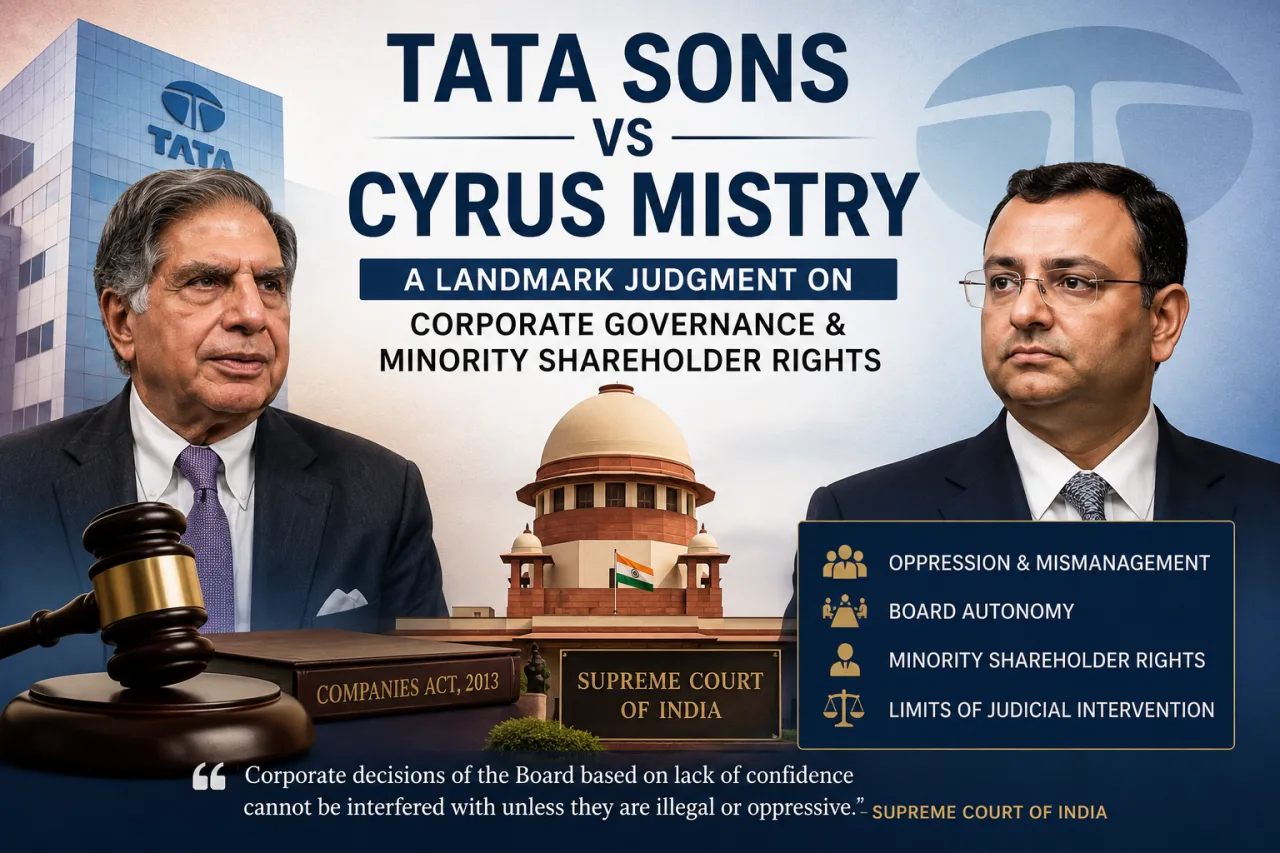
Tata Sons Pvt. Ltd. vs Cyrus Mistry: A Landmark Judgment on Corporate Governance and Minority Shareholder Rights
Introduction
The dispute between Tata Sons Private Limited and Cyrus Pallonji Mistry is one of the most significant corporate governance battles in Indian corporate history. The case raised important questions regarding the powers of a company's board of directors, the rights of minority shareholders, oppression and mismanagement under the Companies Act, and the extent of judicial intervention in corporate decision-making.
The litigation culminated in a landmark judgment of the Supreme Court of India in 2021, which clarified several principles governing corporate management and shareholder rights.
Background of the Dispute
Cyrus Mistry was appointed as the Executive Chairman of Tata Sons in December 2012, succeeding Ratan Tata. During his tenure, Mistry initiated various strategic and governance reforms within the Tata Group.
On 24 October 2016, the Board of Directors of Tata Sons passed a resolution removing Cyrus Mistry from the position of Executive Chairman. Subsequently, N. Chandrasekaran was appointed as the new Chairman of Tata Sons.
Following his removal, Cyrus Mistry and companies belonging to the Shapoorji Pallonji Group, which held approximately 18.37% shareholding in Tata Sons, challenged the decision before the National Company Law Tribunal (NCLT), alleging oppression of minority shareholders and mismanagement of the affairs of the company.
Issues Before the Tribunal
The principal issues raised in the proceedings included:
-
Whether the removal of Cyrus Mistry as Executive Chairman constituted oppression of minority shareholders.
-
Whether the affairs of Tata Sons were conducted in a manner prejudicial to the interests of minority shareholders.
-
Whether the conversion of Tata Sons from a public company to a private company was valid.
-
Whether the National Company Law Appellate Tribunal (NCLAT) was justified in reinstating Cyrus Mistry as Executive Chairman.
-
Whether the conduct of Tata Sons amounted to mismanagement under the Companies Act, 2013.
Proceedings Before NCLT and NCLAT
The NCLT dismissed the allegations made by Cyrus Mistry and held that the removal of the Executive Chairman was within the powers of the Board and did not amount to oppression or mismanagement.
However, the NCLAT reversed the decision and ordered the reinstatement of Cyrus Mistry as Executive Chairman of Tata Sons. The NCLAT further set aside the company's conversion from a public company to a private company.
Aggrieved by the NCLAT decision, Tata Sons approached the Supreme Court of India.
Supreme Court Judgment
In March 2021, the Supreme Court delivered its landmark judgment in Tata Sons Pvt. Ltd. v. Cyrus Investments Pvt. Ltd. and Others.
The Court set aside the NCLAT judgment and upheld the decision of the NCLT. The Supreme Court ruled in favour of Tata Sons and held that the removal of Cyrus Mistry as Executive Chairman did not constitute oppression of minority shareholders.
The Court observed that a company's Board of Directors possesses the authority to remove an Executive Chairman in accordance with its Articles of Association and applicable corporate governance principles. Mere removal from a managerial position does not automatically establish oppression under company law.
Key Findings of the Supreme Court
1. Loss of Confidence is a Valid Ground
The Supreme Court recognised that corporate leadership is based substantially on trust and confidence. Once the Board loses confidence in an Executive Chairman, it is within its powers to replace such leadership.
The Court observed that commercial decisions of the Board should not ordinarily be interfered with unless they are unlawful or oppressive.
2. Minority Shareholding Does Not Confer Management Rights
The Court clarified that minority shareholders are entitled to protection against oppression and mismanagement but do not possess an inherent right to participate in management merely by virtue of their shareholding.
The Shapoorji Pallonji Group's minority shareholding did not create a legal right to control management decisions within Tata Sons.
3. Judicial Review Has Limits
The Supreme Court emphasized that courts and tribunals should not act as appellate bodies over commercial decisions taken by company boards.
Judicial intervention is warranted only when decisions violate statutory provisions, are fraudulent, oppressive, or constitute mismanagement.
4. Reinstatement of a Chairman is an Extraordinary Remedy
The Court held that reinstatement of an Executive Chairman is not a normal remedy in cases alleging oppression and mismanagement.
The NCLAT had exceeded its jurisdiction by directing reinstatement without sufficient legal basis.
5. Conversion into a Private Company
The Supreme Court upheld the conversion of Tata Sons into a private company and found no legal infirmity warranting interference.
Significance of the Judgment
The Tata Sons–Cyrus Mistry judgment is regarded as one of the most important corporate law decisions in India. The ruling reaffirmed the autonomy of corporate boards and clarified the distinction between shareholder rights and management rights.
The decision strengthened the principle that corporate governance disputes must be examined from a legal perspective rather than through the lens of business disagreements alone.
The judgment also reinforced the limited scope of judicial review in corporate affairs and highlighted the importance of Articles of Association in determining the rights and obligations of shareholders and directors.
Impact on Corporate Governance
The judgment has had a significant influence on Indian corporate governance practices. It has encouraged companies to ensure that their Articles of Association clearly define governance structures, powers of directors, and procedures for appointment and removal of key managerial personnel.
The ruling further provides guidance to boards, investors, and promoters regarding the balance between managerial authority and minority shareholder protection.
Conclusion
The Supreme Court's decision in Tata Sons Pvt. Ltd. v. Cyrus Mistry remains a landmark precedent in Indian corporate law. The judgment clarified critical issues relating to oppression and mismanagement, minority shareholder rights, board autonomy, and judicial intervention in corporate decision-making.
The case serves as an important reference point for companies, directors, shareholders, legal professionals, and corporate governance experts seeking to understand the legal framework governing modern corporate management in India.